

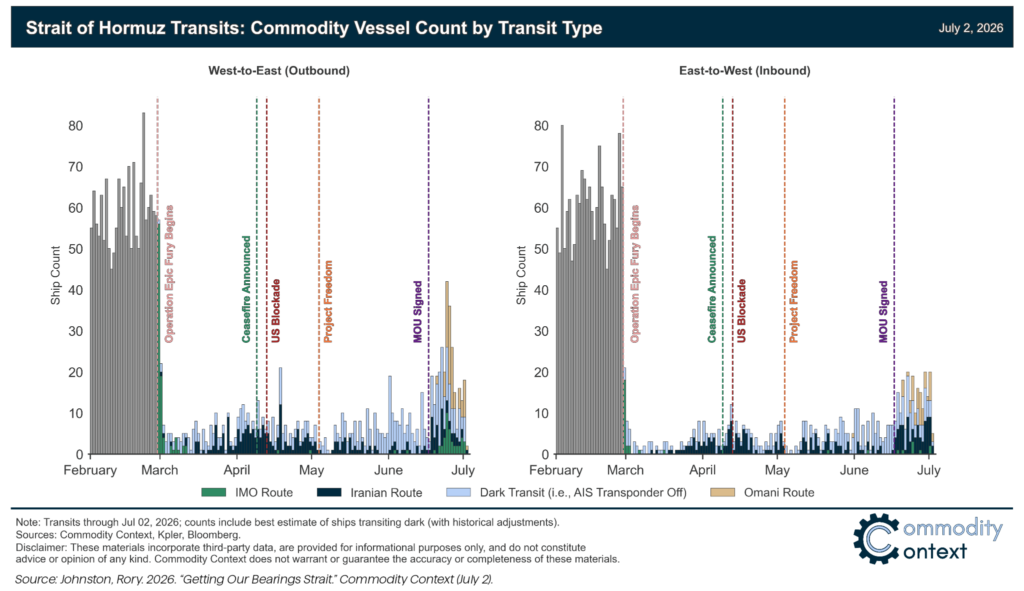
When I last wrote, I suggested the market was fixating on the immediate inconvenience of the Strait of Hormuz while missing the larger rearrangement behind it, and that anyone assuming a swift return to Gulf normality was being, in the British manner, “somewhat optimistic.” The near-term half of that has aged well. The noise has subsided, the stranded tankers are filing out of the Gulf, and Brent has completed a round trip that would embarrass a fairground ride—from a four-year high above $126 in April to the low $70s now, which is to say, roughly where it sat the day before the war began. The war premium has not so much deflated as been refunded in full.
I would now gently suggest this is the wrong conclusion drawn from the right facts. Consider what actually produced the fall, because none of it describes a healthy market.
Close to a hundred million barrels of previously stranded crude are draining onto the water as Hormuz reopens, and a backlog clearing is not the same thing as a market loosening. The forward curve, meanwhile, has spent four months pricing a reopening it kept believing was eight weeks away; Brent being a contract delivered into the future, the perpetual promise of imminent normality has sat on prices the entire time. And there has been a genuine, if brutal, rebalancing of flows: the United States has pushed crude and product exports from around five million barrels a day to nine, while China has quietly cut net imports from some thirteen million barrels a day to seven and a half, drawing down its own inventories rather than pay wartime prices.
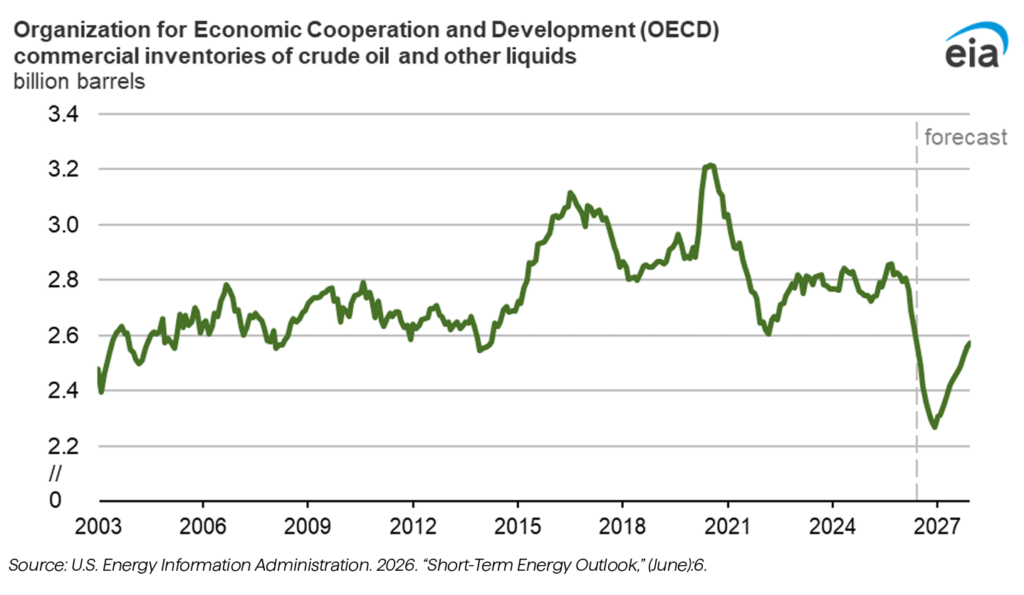
The system found its balance not through new supply but by consuming its buffers — OECD stocks run down toward levels last seen in 2003 and, on the sell side’s own arithmetic, to within touching distance of the operational floor beneath which pipelines lose pressure, terminals cannot load, and refiners cannot source their grades. The system does not seize because the oil has gone; it seizes because too little of it is left in motion to keep the machinery turning. The market has, in short, sold most of the fuel and pronounced the car lighter and therefore faster.
Into this arrives the past week’s most eye-catching development, and one widely mis-described. Saudi Arabia has not cut production—quite the reverse, nominally. It has cut price.
The mechanics are the story. Aramco sells its term barrels not at an outright price but at a monthly differential to a regional benchmark, and that differential is about as honest a demand signal as the oil market produces. As recently as July, Arab Light carried a premium of nearly ten dollars; a month later it is offered at a discount, for the first time since the 2020 price war. This is not a response to abundance but to absence—the Asian buyers lost during the war have not returned, and Riyadh is discounting to win them back. That the cut lands alongside the fifth consecutive OPEC+ quota increase—volumes that remain largely notional, since Hormuz still caps how much Gulf crude can physically move—merely sharpens the point. It is a scramble for market share dressed up as a supply glut.
It is also not obviously sustainable. Riyadh needs an oil price in the mid-to-high eighties merely to balance its budget on the IMF’s reckoning, and nearer ninety to close the gap in full—before one so much as mentions the giga-projects. A sovereign defending market share by discounting into a $71 market, with Aramco’s cash flows now straining against a dividend it shows no appetite to trim, is a coiled spring, not a new equilibrium. Price wars are most expensive for the people who start them.
So, I find myself in the faintly absurd position of arguing that oil is too cheap while the headlines celebrate its return to normal. The flat price has round-tripped below its pre-war level; the physical system beneath it is measurably more fragile than before the war began. Qatari LNG capacity remains offline and will stay so for years—the loss equivalent to roughly three-quarters of the Russian pipeline gas Europe lost in 2022—while around a fifth of the world’s LNG still threads the very strait everyone has agreed to stop worrying about. Distillate cracks sit near multi-year highs as we enter the seasonal peak, a tax on the productive economy of trucks, ships, and factories rather than merely on the motorist. And the restart, when it comes, will be neither quick nor clean: shut-in wells lose reservoir pressure and temperature, wax and asphaltenes settle out to plug the tubing, and the number of Gulf wells that struggle to come back rises with every month they sit idle—which is why the Gulf’s own national oil companies now concede that full flows are unlikely before 2027. The forecasters are nonetheless already sketching a 2027 glut, assuming everything reopens on schedule and stays open. That is a great deal of assuming.
None of this argues for melodrama, and I would concede there are possible outcomes in either direction. But the distinction I drew last time holds. The market is again pricing what is visible and immediate—the tankers leaving, the premium unwinding, the Saudis discounting—and underpricing what is structural and delayed: the vessels reluctant to return, the inventories that must be rebuilt, the LNG that cannot be, the wells that will not simply switch back on, and a lead producer now selling at a loss to a customer who has wandered off.
For portfolios, the implication is much as before, only cheaper to act upon. Pause on the oddity that many energy equities have fallen through all this even as the single largest supply disruption in the market’s history unfolded. Secure, low-cost producers and non-Hormuz gas infrastructure now change hands at valuations that quietly discount a long-term oil price in the low seventies: below even a conservative through-cycle estimate, and a world away from what the physical picture arguably justifies. I am inclined to take the other side of that.
In fixed income I remain wary of duration: the inflationary impulse looks rather less transitory than the calm in crude implies—distillate cracks are still stretched, and the same energy shock is feeding through Asian producers into the price of the goods the West imports—and I continue to find TIPS and selective curve steepeners useful.
The calm is real. The repair is not. We will see how this pans out.
Disclosure: Ben Ashby is Head of Fixed Income & Foreign Exchange at Rayliant Investment Research. This material is for informational purposes only and should not be considered investment advice. An investor should consult with their financial professional before making any investment decisions. The opinions expressed are those of the author as of the date of publication and are subject to change without notice.
You are now leaving Rayliant.com
The following link may contain information concerning investments, products or other information.
PROCEED