“So, we were sitting there at the end of last year basically saying, ‘We haven’t seen the models yet… we’re gonna write this check for, I don’t know, $100 billion or $200 billion.’
And I’m looking across the table like, ‘Alex, are you sure this is gonna work?’”
—Mark Zuckerberg, Meta Platforms CEO, describing a conversation
with Meta’s Chief AI Officer, Alexandr Wang, about Meta’s enormous infrastructure capex
Back in October, Meta founder and CEO Mark Zuckerberg brought his Chief AI Officer, Alexandr Wang, along for a visit to the pub with Stripe co-founder John Collison, who routinely hosts tech luminaries on his popular Cheeky Pint podcast. Clips of the sit-down went viral, centering on the Meta CEO’s anguished facial expressions as he attempted to “enjoy” his first glass of Guinness. We were more struck by Zuckerberg’s account of the company’s massive AI infrastructure investments, which were made, the pair revealed, on the basis of little more than a “vibe report” from Wang. It’s not the first time Zuckerberg has thrown big numbers around: On the Access podcast with Alex Heath and Ellis Hamburger last year, he suggested that “If we end up misspending a couple of hundred billion dollars, I think that that is going to be very unfortunate, obviously… But what I’d say is I actually think the risk is higher on the other side.”
If you hear the ring of “FOMO” in Zuck’s description of his firm’s capital budgeting discipline, you’re not alone, and we imagine many US stock investors have likewise thrown caution to the wind in the interest of not being “left behind” by the AI revolution. The good news for such investors is that AI momentum has so far handsomely rewarded a FOMO-based investment policy, leading to eye-popping returns for what’s seemed like an increasingly crowded trade. Only recently have stocks in the theme begun experiencing the kind of volatility that raises questions as to whether the AI stock gravy train keeps rolling from here or goes spectacularly off the rails.
Whether that question should concern an equity investor or not could depend on where, exactly, that investor is allocated within the AI space. Even though we often talk about “the AI trade”, as though there’s only one way to play this theme, a peek into most thematic AI portfolios yields a range of ways equity investors actually get exposure to this technological transformation. As the figure below illustrates, how one’s AI investments have performed can also vary substantially based on the nature of those investments.
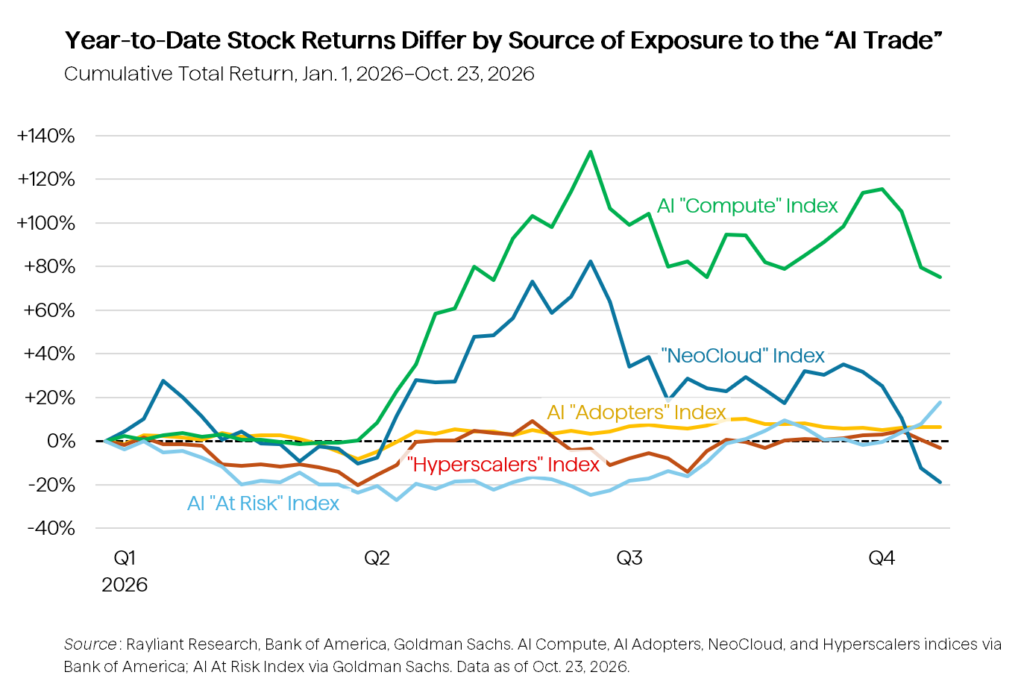
Take chipmakers, for example, which have been the best performers associated with the AI boom, and which many observers likely consider the clearest embodiment of the AI hardware theme. Stocks in this industry, including Nvidia, Broadcom, and AMD—purveyors of the proverbial ‘picks and shovels’ powering AI model-builders—make up the Bank of America “AI Compute” Index, and have returned around 80% year-to-date. In fact, the AI chipmaker basket was up much more, roughly 120% YTD, back around the middle of summer, before that aforementioned volatility prompted a pullback.
That second-half AI angst was more painful for another set of stocks in the AI hardware space, the so-called “neo-cloud” providers loading up on debt to build datacenters they rent to hyperscalers like Meta and Alphabet. As bond yields have surged, so have doubts these companies will survive, squeezed between an increasing cost of capital and burgeoning skepticism over both competition in the space and the sustainability of demand for the infrastructure they’re investing so much to expand. Drawdowns like these—from up 80% to 20% in the hole, in just a matter of months—are a reminder that the higher valuations climb, the farther they have to fall when sentiment turns.
Along those lines, companies the market perceives as having a lot to lose as AI applications take root—in other words, the “shorts” of the AI trade, including enterprise software-as-a-service providers, like Adobe, Salesforce, and ServiceNow—had struggled mightily in the first half of the year. Names tracked in Goldman Sachs’ AI “At Risk” Index, for instance, had fallen by over 20% by the end of Q1. That same basket of stocks, arguably oversold after month upon month of doomsday headlines, has staged a big comeback over the last few months as investors reevaluated those overly SaaSpocalyptic visions, bouncing to a 20% year-to-date gain near the end of October.
If hardware stocks sitting on massive gains and increasingly lofty expectations are most exposed to a reversal in AI sentiment and software stocks have already begun to rebound, where might investors search for the next set of opportunities—or, at the very least, a tech ‘safe haven’ to weather setbacks in the AI theme? Hyperscalers could merit a look. Investors’ ambivalence toward big capex outlays has kept these stocks’ valuations in check, and diversified businesses throwing off loads of cash do tend to provide a buffer when the mood goes to ‘risk off’. Companies in the “AI adopters” category, which benefit most from applying AI to reduce costs and boost profitability, have also seen much more muted performance thus far and could provide another good pool of prospects for stock-pickers who view the “AI trade” as encompassing more than just hardware.
Disclosure: This material is for informational purposes only and should not be considered investment advice. An investor should consult with their financial professional before making any investment decisions. The opinions contained herein are subject to change without notice and do not necessarily reflect the opinions of Rayliant Investment Research. Indices cannot be invested in directly and are unmanaged. Past performance is not indicative of future results.
You are now leaving Rayliant.com
The following link may contain information concerning investments, products or other information.
PROCEED