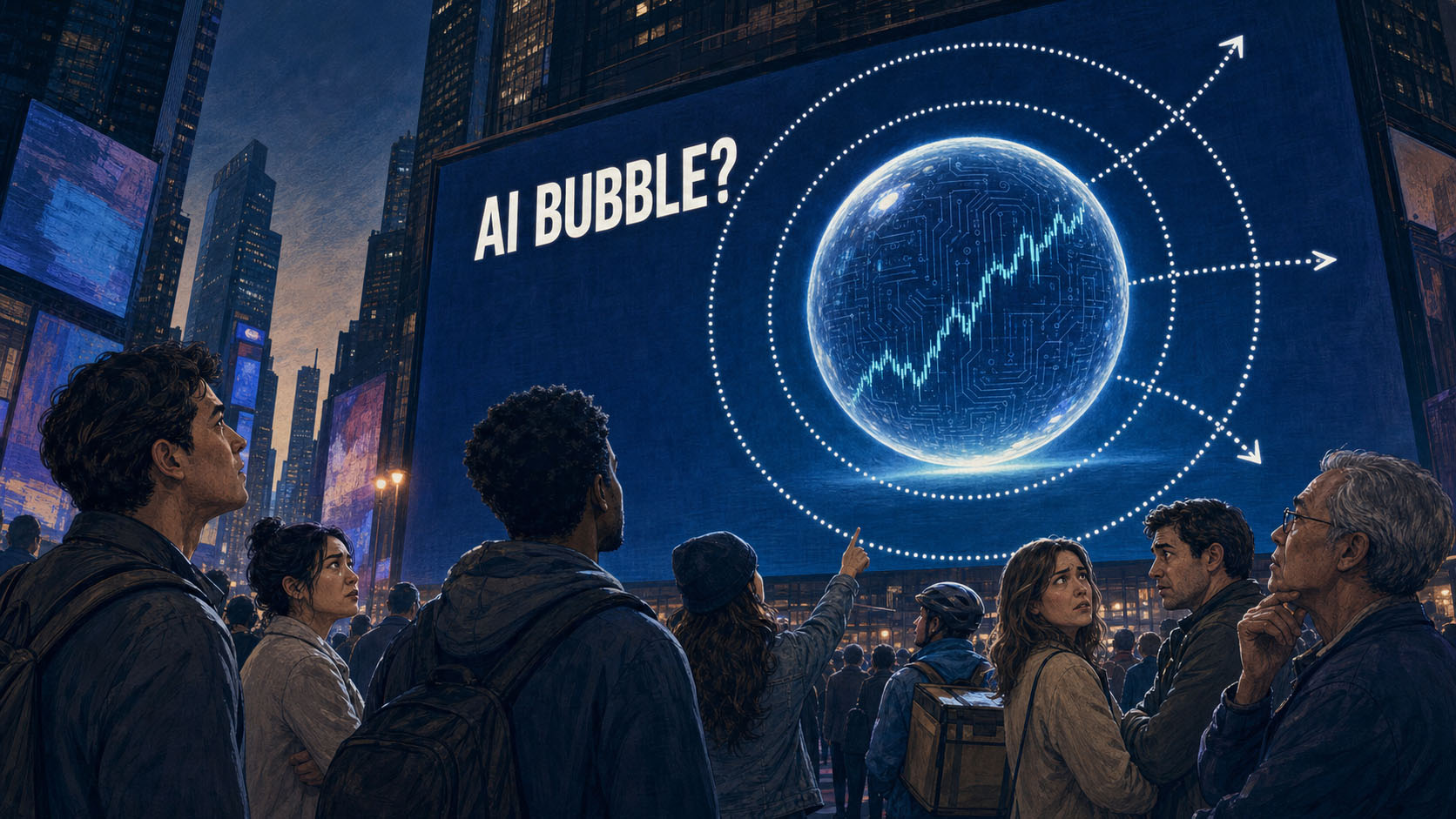

When I sat down at the beginning of July to write about what’s been happening with tech stocks in 2026, I simply wanted to talk readers through the elephant in the room: Are we in an AI hardware bubble and what can investors do about it?
I don’t have a crystal ball, but I do have a Bloomberg terminal, and AI hardware stocks were flashing enough green that I felt I had to write something. Take, for example, the Goldman Sachs US AI Semiconductor Index, tracking companies selling chips that power the AI revolution: In the first six months of 2026, it had literally doubled in value. Add in 2025’s gain, and the index had tripled its value in just a year and a half.
As an investor, you see something like this and you have two thoughts: First, “Can gains like that really sustain?”—and second, “What if I sit it out and I miss the next 100% rise?”
That late-June mark turned out to be high-water, and the market made my comments look pretty timely: AI investors started getting jitters about hardware makers’ growth and a potential slowdown in datacenter capex, and some of the air came out of the AI hardware trade. From the end of June to July 29, 2026, that Goldman AI Semis Index crashed down 27%.
Now, entering August, AI stocks are bouncing back, the S&P 500 Index is again flirting with record highs, and investors are asking the same question they were at the end of June—maybe now with just a little more anxiety than before: “Is this 1999 all over again?”
So, in case you missed my thoughts on that question, I’d like to share them one more time… Are we re-living the 1999 boom and burst?
As your honest, but characteristically equivocal economist, my answer is “Yes, this is a FOMO bubble,” BUT ON THE OTHER HAND “AI will change life and business even more profoundly than the internet,” and, finally—the part that matters most to investors—“This bubble might run for another 18 months and bring all rational investors to their knees… or burst next quarter.”
To be sure, this current raging bull market has all the hallmarks of the Dot-Com era: 1) a genuinely transformative technology that we can only begin to imagine its full impact on productivity and future product innovation, 2) a valuation frenzy that feels disconnected from any rational or even irrational growth projection, and 3) babbling tech bros who celebrate self-anointed prophets like Messiahs.
But there is one critical difference between 1999 and today—a difference that suggests this bubble could get much bigger and last much longer than we think.
The internet bubble of the late 90s was fueled by venture capital. It depended on external money to finance the dreams of Yahoo, Webvan.com, and Pets.com. When the VC well ran dry, the party ended abruptly. The underlying companies were burning cash with no end in sight. There just wasn’t enough willing capital to throw itself after bad money.
Today is different. The AI revolution isn’t being funded by VCs hoping for an exit; it is being funded by the “Magnificent Seven”—the richest, most cash-flow-positive companies in the history of capitalism. They are the eternal spring of growth capital!
Microsoft, Apple, Google, Meta, Nvidia, Amazon, Tesla —these companies are minting money faster than the government can print it. They don’t need external funding to keep the AI party going. They can afford to be incredibly patient. They can easily shrug off bad IRR, which would otherwise doom a VC fund, in the name of strategic investment; regardless, given their current size and profitability, poor ROI on incremental CAPEX is entirely negligible. They can throw tens of billions of dollars at infrastructure and R&D year after year without blinking.
This combination of “patient growth capital” and “extremely deep pocket with low shareholder governance” results in a CAPEX spending spree that is not dissimilar to the US government’s unchecked spending financed by a printing press. As a result, the bubble has a much stronger structural support system than it did in 1999. It means the runway is longer. We might be in the 5th inning, not the 9th.
So, how do you talk to a client who sees this run-up and wants to chase it? Or conversely, a client who is terrified it will all collapse tomorrow?
The advisor’s job isn’t to predict the top. Even the best investors in the world can’t do that. Your job is to frame the trade-off.
Sit down with your client and say this:
“Look at your portfolio. Because you own the S&P 500, you have already participated in this spectacular run. You own NVDA. You own META, TSLA, and MSFT. You have won.”
“We might be in the middle of a 9-inning baseball game. It could go up another 50% or even 100%. But we also know how this story ends. When the internet bubble burst, the NASDAQ dropped nearly 80% and spent the next 15 years in recovery.”
“So here is the choice: What is more important to your retirement right now? Is it the excitement of riding this wave to the absolute bitter end? Or is it the predictability of knowing your retirement plan is secure—and even accelerated because you were lucky enough to have participated in a raging bull market and wise enough to have taken profit.”
This isn’t about being a bear. It is about defining “enough.”
If a client chooses to de-risk, they aren’t “missing out.” They are exchanging potential upside for guaranteed peace of mind. They are cashing out their winning lottery ticket instead of rolling it back in hoping for more big wins.
By making this an explicit decision—by saying, “We acknowledge we might leave money on the table, and we are okay with that because we prefer certainty”—you inoculate the relationship against regret. You take yourself out of the impossible game of market timing and put yourself back in the role of the fiduciary.
In my view, the AI bubble is real. It is powerful. It is backed by nearly limitless capital. It could run for years. But you don’t need to bet the farm on it to have a successful retirement. You just need to decide when you’ve won—and you have already won.
Disclosures: The views expressed in this article are those of Jason Hsu and are provided for informational and educational purposes only. They do not constitute investment advice, a recommendation, or an offer or solicitation to buy or sell any security. References to specific securities are for illustrative purposes only and do not constitute a recommendation to purchase, hold, or sell those securities. Past market events and performance are not indicative of future results. Investing involves risk, including the possible loss of principal. This material is intended primarily for financial professionals, including independent financial advisers and registered investment advisers. Rayliant Investment Research is a registered investment adviser. Registration does not imply a certain level of skill or training.
You are now leaving Rayliant.com
The following link may contain information concerning investments, products or other information.
PROCEED