

As I have observed before, one of Britain’s great historical traditions is the financial mess. It’s not that we are innately prone to them; we just have a longer history and therefore more opportunity. So, when American friends ask me about private credit, my honest answer is that I have a nagging feeling I’ve seen this one before, and on our side of the Atlantic it did not end well.
Last October, a committee of the UK Parliament’s Upper House put it to the Governor of the Bank of England that post-2008 rules had “squeezed the balloon, moving risk outside the banking system.” He didn’t think so. Well, he would say that; he also thought inflation was transitory. The expression Parliament used is an old City adage: squeeze a balloon in one place, and it bulges somewhere else.
Call the bulge a new asset class, produce a reassuring chart, and you can usually charge a management fee for it.
This year, investors in the bulge discovered what “semi-liquid” means. BlackRock’s HPS fund was asked for 13.3% of its shares in the second quarter and paid out 5%. Blue Owl’s two retail funds were asked for 18.8% and 38.1% and did the same. In September, Morgan Stanley’s North Haven fund said it would meet about 44% of each request.
This isn’t new on your side of the Atlantic. Before 2008, hedge funds such as D.B. Zwirn did a lot of direct lending while offering periodic liquidity. When Zwirn’s clients asked for more than $2 billion back, it shut its main funds in February 2008. Investors wanted their money back in a quarter. The loans took years.
Apparently, the democratization of private markets includes the right to queue with everybody else.
Before anybody panics: a gate is not a default. It’s in the prospectus, and it stops those leaving from forcing a fire sale on those who stay. In a market this big, grown this fast, some funds will have serious problems, and plenty will be fine, which is not the same as saying the asset class is rotten. What a gate does tell you is that you can’t leave when you want to, and that matters rather a lot when the money is needed for something inconvenient, like living on.
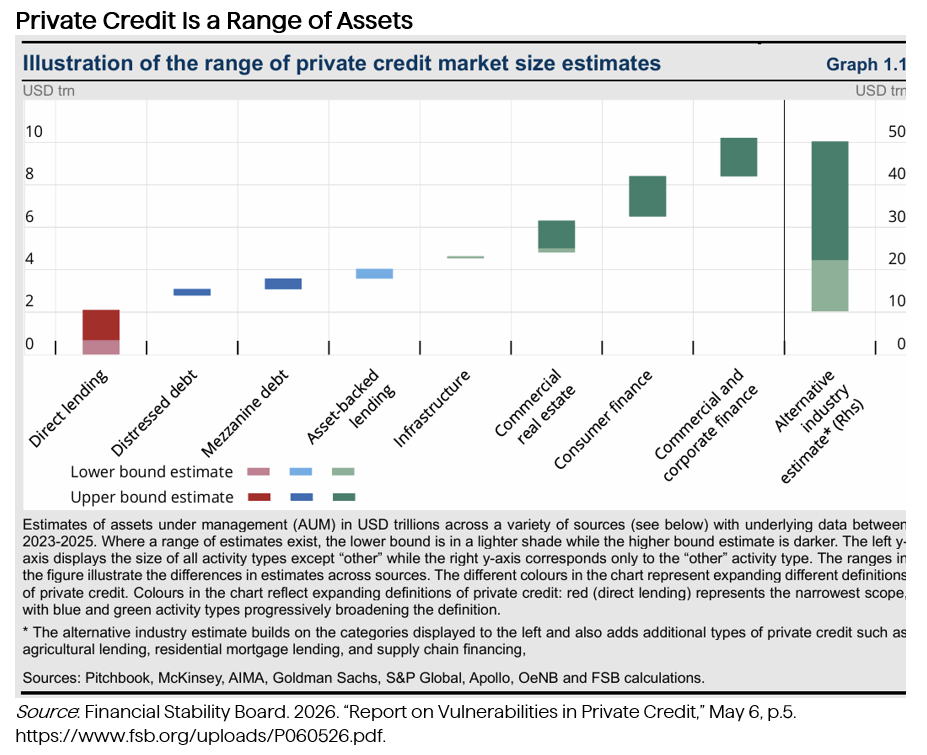
Two things filled the balloon. After 2008, Dodd–Frank and Basel III made it expensive for banks to lend to mid-sized, heavily indebted companies, and the borrowers, rather inconsiderately, didn’t vanish. They went to private credit funds. Then a decade of near-zero rates supplied the money. Walter Bagehot quoted the saying in 1873: “John Bull can stand many things, but he cannot stand two per cent.” It turns out Uncle Sam can’t either.
Some of what investors bought is exactly what it says on the tin: senior loans to decent companies, with proper covenants, held to maturity. People have done that profitably for decades. But a market that has grown to somewhere between $1.5 and $2 trillion doesn’t stay that disciplined:
Now back to dark tales from the City of London. In the late 1960s, the Bank of England capped how much each bank could lend. The lending didn’t stop. As the Bank later admitted, it simply moved to firms outside the rules because they weren’t technically banks. These “secondary” banks—what we would now call shadow banks—borrowed short in the money markets and lent long, mostly on property, and when the caps came off in 1971, the boom did the rest.
Then interest rates went from 5% to 13%, an oil shock quadrupled the price of crude, and the money left. The buildings couldn’t follow it. By the end of 1973 the Bank of England had launched a rescue it called the Lifeboat. The big UK banks, the very ones the “secondaries” had grown up to get around, soon lent well over £1 billion (about 40% of the sector’s capital at the time) to the bailout.
Fifty years on, the banks still haven’t really left. In May the Financial Stability Board counted around $220 billion of bank credit lines to private credit funds, with commercial estimates up to $500 billion. When MFS, a London mortgage lender, collapsed in February amid accusations of fraud and double-pledged collateral, Barclays turned out to be owed about £500 million, and America’s own Jefferies seems to have a $42M loss, though I suspect this will grow. That was our own little omnishambles. We moved the loan. We didn’t move it very far.
Our other experiment was at Lloyd’s of London. In 1970 Lloyd’s lowered the wealth requirement for its Names, the individuals who backed its insurance with unlimited personal liability. Membership went from about 6,000 to over 32,000 by 1988. The newcomers took on old liabilities at prices set by insiders, and when the asbestos claims arrived, thousands were ruined. Democratization, 1970s style.
Private credit also needs a steady supply of new money, because the old money wants out. In the first quarter, HPS took in about $840 million from new investors while paying roughly $620 million to leavers. If the valuation is right, nobody loses. If it’s too high, newcomers have paid leavers the price the manager set.
Neither the UK shadow banks nor the Lloyd’s Names were big enough to sink the system on their own. What turned 1973 into a crisis was the backdrop: rates up, oil up, and everything built on cheap money exposed at once.
Private credit is overwhelmingly floating rate, which protects lenders from rising rates right up to the point where borrowers can’t pay them. Brent crude was about $105 a barrel last week, half as much again as a year ago, and on September 16, 2026, the Federal Reserve raised rates for the first time since 2023. Nobody is talking about 13%. But the sequence is familiar. Systemic leverage is higher now than in the 1970s, so there is likely a tipping point, but—alas—nobody knows when.
The Financial Stability Board noted in May that private credit “remains untested to a prolonged economic downturn.” It may be about to sit the exam. I don’t know which of today’s funds will turn out to be this cycle’s shadow bank, and I suspect their managers don’t either.
None of this is a reason to drag clients out the back gate. If the underwriting was careful and the client doesn’t need the money, patience may well be rewarded. Bargains will also appear when forced sellers arrive: The hedge fund Saba set out in April to raise a billion dollars for exactly that. But I’d ask three questions:
The job is to make sure the ones who can’t aren’t standing in the queue.
Take it from the British. We have squeezed this balloon before, and it has never once gone down quietly, and it’s a bad way to end a party.
AltsWire. 2026. “HPS Corporate Lending Fund Sees Q2 Redemption Requests Jump to 13.3%.” AltsWire, June.
Asness, Cliff. 2023. “Volatility Laundering.” Perspectives, AQR, January 6.
Brush, Silla and Olivia Fishlow. 2026. “BlackRock $26 Billion Private Credit Fund Limits Withdrawals.” Bloomberg, March 6.
Financial Stability Board. 2026. “Report on Vulnerabilities in Private Credit.” May 6.
Fink, Laurence. 2025. “The Democratization of Investing.” Larry Fink’s 2025 Annual Chairman’s Letter to Investors.
Hamilton, Dane. 2008. “D.B. Zwirn to Liquidate $4 Billion in Assets.” Reuters, February 22.
Morgan Stanley Private Credit. 2026. “North Haven Private Income Fund Investor Update.” September. Exhibit (a)(1)(vi) to Schedule TO-I/A, SEC EDGAR.
O’Connor, Jessica. 2026. “Jefferies Reports $42.8M Mark-to-Market Loss Linked to MFS Collapse.” The Intermediary, April.
Reuters. 2026. “Blue Owl Keeps Withdrawal Cap as Redemption Requests Remain Elevated.” Via Investing.com, July 2.
Singh, Preeti. 2026. “Private Secondaries Deals Surge to Record $226 Billion, Evercore Reports.” Bloomberg, January 16.
Stumpp, Pamela, Tom Marshella, M. Rowan, R.K.V. McCreary, and M. Coppola. 2000. “Putting EBITDA in Perspective Ten Critical Failings of EBITDA as the Principal Determinant of Cash Flow.” Semantic Scholar.
Wikipedia. “Walter Bagehot.” Last updated September 8, 2026.
Disclosures: Ben Ashby is Head of Fixed Income & Foreign Exchange at Rayliant Investment Research (“RIR”), an SEC-registered investment adviser; registration does not imply any level of skill or training. He is employed by Henderson Rowe Limited, an affiliate of RIR, and is a member of Sowell Management’s OCIO team. This material is informational only; it is not investment, tax or legal advice, or an offer or solicitation to buy or sell any security, and does not consider any investor’s individual objectives, financial situation or needs. Investors should consult their financial professional before making investment decisions. Views are the author’s as of the publication date and may change. Past performance does not guarantee future results. Third-party data is believed reliable but not guaranteed.
You are now leaving Rayliant.com
The following link may contain information concerning investments, products or other information.
PROCEED